
Best red chilli varieties in India for export
Quick answer
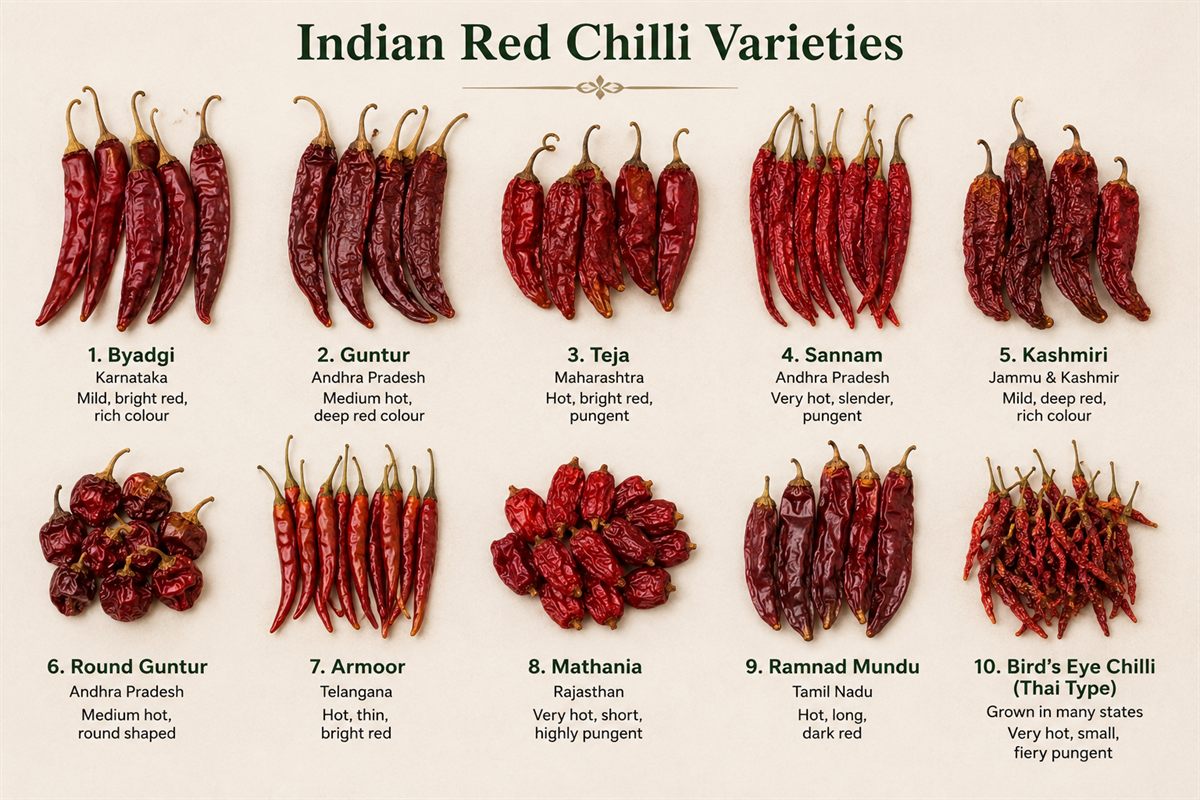
The best red chilli varieties for export from India are Guntur Sannam S4 (heat-driven, 35,000–40,000 SHU, ASTA 32–38), Teja S17 (highest pungency at 75,000–1,00,000 SHU), Byadgi Kaddi (low-heat, deep-red, oleoresin-grade), Kashmiri Deghi Mirch (colour-only, under 2,000 SHU), 334 Wonder Hot and 341 Indo-5 (balanced Telangana hybrids). Which one is right depends on whether your end product needs heat, colour, capsaicin yield, or the lowest predictable cost per kilogram.
If you're a first-time importer of Indian dry red chilli, the catalogue can look bewildering — there are easily two dozen varieties traded in any given mandi week. The good news: roughly six varieties account for the overwhelming majority of containers that actually leave Indian ports. This piece walks through each one from the buyer's seat.
We'll cover what each chilli is good for, who buys it, where it sources from, and the price band it usually trades in relative to the others. By the end, you should be able to walk into a quote conversation knowing roughly which variety fits your end-use.
1. Guntur Sannam S4 — the workhorse
If India's chilli export had a default setting, this would be it. Long, slender, deep-red pods grown primarily around Guntur and the surrounding Andhra Pradesh and Telangana farm-belt. Heat sits in the 35,000–40,000 SHU range, ASTA colour around 32–38, and supply is the most consistent of any variety we trade.
Guntur Sannam goes into curry powder bases, commercial sauces, pickles, and supermarket retail packs. It's the variety we recommend for first-time buyers — the price band is predictable, the grade is well-understood at every Indian port, and your end customer almost certainly knows what to do with it.
2. Teja S17 — the heat workhorse
If Guntur Sannam is the volume default, Teja is the heat default. Bright red, shorter pods, and a Scoville range of 75,000–1,00,000. ASTA colour 68–82. Sourced primarily from the Khammam region of Telangana.
Buyers: Chinese and Korean sauce manufacturers, Sichuan-style restaurant chains, instant noodle seasoning packers, and oleoresin extractors who need high capsaicin yield per kilogram. Teja is one of the most price-sensitive varieties in our catalogue — it's worth booking when the harvest hits the yard rather than mid-season.
3. Byadgi Kaddi — the colour king
Almost the opposite of Teja in profile. Mild heat (8,000–15,000 SHU) but extraordinary colour (ASTA 82 up to 160 in top grades). Wrinkled, deep crimson pods sourced primarily from Haveri and surrounding Karnataka.
Byadgi is a colour ingredient before it's a heat ingredient. Sambars, rasams, oleoresin extraction for natural food colourants — and increasingly, premium retail packs in the Middle East and the UK that want "deep red" without burning the consumer. If your buyer is asking for ASTA above 80, Byadgi is the answer.
4. Kashmiri Deghi Mirch — the premium retail pick
The lowest-heat variety we ship in any volume — typically 1,000–2,000 SHU — but with vibrant colour (ASTA 100–130) and a distinctive aroma. Sourced from the Kashmir Valley via established partner networks.
Kashmiri is what gives tandoori chicken its glow without making it eye-watering. It's the right answer for premium retail packs aimed at consumers who want Indian colour without Indian heat. Volumes are smaller than Guntur or Teja, so plan your bookings ahead.
5. 334 (Wonder Hot) — the Telangana hybrid
A modern hybrid widely traded in the Warangal, Khammam and Enkoor mandis. Smooth-skinned, glossy red, with balanced heat (30,000–50,000 SHU) and good colour (ASTA 40–55). The kind of variety the local trade defaults to when they want a clean, predictable curry-powder base at a friendlier price than Guntur Sannam.
If you're a blender of mid-shelf retail spices, 334 deserves a sample order. Most buyers we ship 334 to compare it against Guntur Sannam and end up doing partial swaps for the cost saving.
6. 341 (Indo-5) — 334's hotter sibling
Closely related to 334, but longer pods and a sharper bite — 40,000–55,000 SHU, ASTA 45–60. Trades briskly in the same Telangana yards. Particularly favoured by South-East Asian sauce manufacturers who want Guntur-region terroir at a slightly higher heat reading.
The single most useful question to ask before picking a variety: what is your end customer using the chilli for? Heat, colour, and price all flow from that.
Quick recommendation matrix
- Curry powder blender → Guntur Sannam, 334, Reshampatti
- Hot sauce / oleoresin → Teja S17, Bhut Jolokia (small volume), Dhani
- Premium retail with deep colour → Byadgi Kaddi, Kashmiri Deghi
- Restaurant supply / HoReCa → Kashmiri Deghi, Guntur Sannam
- Pickle bases & oil infusions → Reshampatti, Jwala, 341
- South-East Asian sauces → Teja S17, 341, Dhani
What about samples?
Most of our buyers start with a 250g–1 kg courier sample of the variety they're considering, before committing to even a 5 MT trial container. We send pre-shipment photos and lab COA along with the sample so you can verify what the actual lot will look like — not just the marketing image.
The six varieties, side by side
| Variety | Heat (SHU) | ASTA colour | Origin belt | Primary buyer |
|---|---|---|---|---|
| Guntur Sannam S4 | 35,000 – 40,000 | 32 – 38 | Guntur, Andhra Pradesh | Curry powder blenders, sauce manufacturers |
| Teja S17 | 75,000 – 1,00,000 | 68 – 82 | Khammam, Telangana | Hot sauce makers, oleoresin extractors |
| Byadgi Kaddi | 8,000 – 15,000 | 60 – 160 | Haveri, Karnataka | Colour extractors, South Indian masala packers |
| Kashmiri Deghi Mirch | 1,000 – 2,000 | 90 – 130 | Kashmir Valley | Premium retail, HoReCa |
| 334 Wonder Hot | 30,000 – 50,000 | 40 – 55 | Warangal / Khammam, Telangana | Mid-shelf retail blenders |
| 341 Indo-5 | 40,000 – 55,000 | 45 – 60 | Warangal, Telangana | South-East Asian sauce manufacturers |
Ranges are typical export grades. Vijaya Enterprises stocks Guntur Sannam S4, Teja S17 and 341 Indo-5 as its core catalogue; Byadgi, Kashmiri and 334 are sourced on request against a confirmed order.
For a deeper dive into specs and pricing, head to our varieties page. To request a sample of any variety listed above, drop us a brief.
Frequently asked questions
Which Indian chilli variety is the hottest for export?
Teja S17 is the hottest variety traded in commercial export volume, at 75,000 to 1,00,000 SHU. Speciality varieties such as Bhut Jolokia measure far higher but move in small, irregular volumes rather than container loads.
Which Indian chilli has the best colour for oleoresin extraction?
Byadgi Kaddi, at ASTA 60 to 160 in top grades with only 8,000–15,000 SHU. Pigment yield per kilogram, not heat, drives the economics of a colour-extraction lot — so always specify the ASTA grade in writing, never just "Byadgi".
Which variety should a first-time importer start with?
Guntur Sannam S4. Supply is the most consistent of any Indian variety, the price band is predictable, and the grade is well understood at every Indian port — which means fewer surprises on your first container. Most buyers start with a 250 g–1 kg courier sample before a trial load.